

A Personal Note
Before we dive in, I want to share a little about this journey God has me on. It began unexpectedly after I attended the Jordan G. Welch Worship Culture Tour. Over the past year my interest in the Hebrew language has increased significantly. God is maturing me in a way where I am excited to lean more intentionally into my walk with Christ and my purpose in his Kingdom. All of this to say, I would have not imagined, but also do not take it as coincidence, that the morning after her evening worship service, her boot camp, would be the catalyst for such deep study and reflection. I was being moved to go much deeper than I had been going on this discipleship journey.
I thank God for that experience, my best friend who obediently suggested we make time to attend, and I thank God for Jordan G. Welch and her ministry, because through it my relationship with God has been strengthened.
God is so awesome, and his plans for the future involve a close relationship with ALL of his children. Through Jesus, He makes His love for us so clear. He doesn’t hide Himself, and He will do anything and everything to draw us closer.
With all that being said, a few of the words and concepts in this series, like shama, were stirred in me during that weekend, and others the Holy Spirit has placed or seeded in my heart over time. I’m inviting you into this series, not as a journey to simply “understand,” but into my journey to “apply” every word God gives in the way He intended it to be lived out.
Obey/Obedient/Obedience
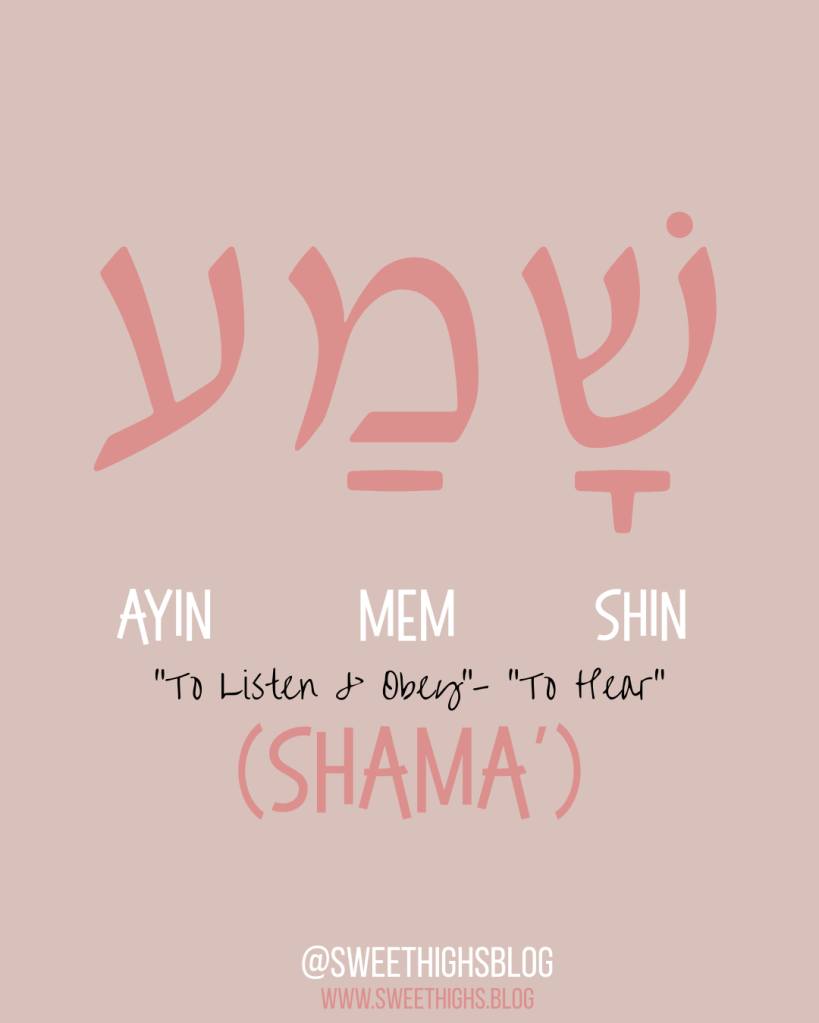
When the Bible says “obey,” it doesn’t mean mindless rule-following. The Hebrew word שָׁמַע (shāmaʿ, Strong’s H8085/H8086) means to hear, listen, and respond. It’s about listening with your whole being so deeply that it changes how you live.
Shāmaʿ in Hebrew
The word shama is spelled with three Hebrew letters, each with a picture meaning (Hebrew4Christians.com):
- ש (Shin) = teeth → to press in, take hold of
- מ (Mem) = water → flow, movement, life
- ע (Ayin) = eye → to see, perceive, understand
Put together: Shāmaʿ means to press in, let it flow into you, and truly perceive.
The Living Water Connection
Hearing in the Bible is not passive. It is active, flowing, and life-giving.
Jesus said:
- “Whoever believes in me, as Scripture has said, rivers of living water will flow from within them.” (John 7:38) NIV
- “but whoever drinks the water I give them will never thirst. Indeed, The water I give them will become in them a spring of water welling up to eternal life.” (John 4:14) NIV
The Mem (מ) — the water at the center of shāmaʿ— points us straight to Jesus, the Living Water. To truly shāmaʿ(hear and obey God), we need His life flowing inside us.
The Lord’s Supper: Take, Eat
When Jesus broke bread and said: “Take, eat; this is my body” (Matthew 26:26), He invited His disciples not just to hear His words, but to receive them into themselves.
That’s the picture of shama:
- Take in (Shin – press in)
- Let it flow (Mem – water, life)
- Truly perceive (Ayin – eye, understanding)
The Lord’s Supper is obedience in action: hearing → receiving → responding.
Shama vs. Legalism
For many of us, the word “obey” might have been associated with fear, condemnation, shame, or strictness. Personally, obedience used to feel like a chore or punishment, a list of tasks I had to complete to prove myself to God. I would often comprehend what I read in the Bible with a rigid tone.
But that’s legalism: obedience without relationship. It puts the weight on us to earn favor by performance.
Shāmaʿis different. It’s not a checklist. It’s an invitation. When God says “Hear, O Israel,” He’s not demanding mechanical compliance. He’s inviting us into intimacy.
- Legalism says: “Do this, or else.”
- Shama says: “Come close. Hear Me. Let My words give you life.”
This helps me to see obedience as a privilege, not a punishment. To shāmaʿ is to receive God’s word as sustenance, like daily bread, like living water.
- It’s a gift of wisdom that protects and guides me.
- It’s a gift of relationship that anchors me.
- It’s a gift of blessing, shaping my life for good in this lifetime, not just eternity.
When I shāmaʿ, I’m not laboring under fear. I’m living under grace. Obedience flows from love and leads back to love.
Scripture Parallels on Obedience
Old Testament
- “Now if you will indeed obey (shāmaʿ) my voice and keep my covenant, you will be my treasured possession. Although the whole earth is mine” (Exodus 19:5) NIV
- “If you fully obey (shāmaʿ) the Lord your God and carefully follow all his commands I give you today, the Lord your God will set you high above all the nations on earth. 2 All these blessings will come on you and accompany you if you obey the Lord your God:” (Deuteronomy 28:1–2) NIV
New Testament
- “If you love me, keep my commandments.” (John 14:15) NIV
- “My sheep listen to my voice; I know them, and they follow me.” (John 10:27) NIV
- “Do not merely listen to the word, and so deceive yourselves. Do what it says..” (James 1:22) NIV
Both testaments agree: real hearing leads to action.
Life Application
- Listening without Jesus is like drinking from an empty cup.
- Listening with Jesus, the Living Water = God’s Word flows into us, fills us, and empowers us to respond.
- Every time you open Scripture, every time you take the Lord’s Supper, you have the choice: Will you just hear, or will you shāmaʿ— hear and obey?
Ask yourself
- Do I approach God’s Word like a rulebook, or like water for my thirsty soul?
- Where is God asking me not just to listen but to act?
- How can I shift from legalistic obedience to relational shāmaʿ?
A Simple Prayer
“Lord, help me not only to hear Your words with my ears, but to let them flow into my heart and life. Lift away fear, shame, and legalism. Let Your Living Water refresh me, guide me, and move me to respond with love and obedience. In Jesus name, Amen.”
True obedience (shāmaʿ) is not a labor of fear but a gift of love. It is God’s way of drawing us close, feeding us with His wisdom, and blessing us with His presence.
Let’s Reflect Together
I’d love to hear your thoughts. How does this word shāmaʿ speak to you personally? Do you see areas where God is inviting you to move from just “hearing” to truly “living” His Word? Share your reflections in the comments — your insight may be the encouragement someone else needs today.
 THE SWEET HIGHS BLOG
Leave a comment